

For claims organizations, closing a file is an important milestone. It means the claim has been resolved, the required work has been completed, and the file can move out of the active claims inventory.
Closing a claim may resolve the loss, but has its potential for recovery been fully considered? For insurers managing high claim volumes and competing priorities, a closed file may still contain information that could reduce loss costs or reveal a broader weakness in the recovery process.
Subrogation can be one of the most effective ways for insurers to offset loss costs, yet potential recoveries can be overlooked amid the demands of day-to-day claims handling. High claim volumes, competing priorities, complex liability issues, incomplete information, and the natural focus on resolving the underlying claim can all contribute.
The result can be a recovery gap: money that may have been recoverable but was never pursued.
As insurers continue to focus on managing loss costs and improving claims performance, understanding where recovery opportunities may be missed has become increasingly important. Reviewing closed claims can provide valuable insight into whether existing recovery processes are working as intended.
Looking at Closed Files with a Different Lens
Reviewing closed claims can provide a different perspective on an insurer’s recovery performance.
Rather than looking only at individual files, a structured review can help identify patterns. Were certain types of claims more likely to have missed recovery opportunities? Are there recurring documentation gaps? Are potential subrogation indicators being identified consistently? Are there points in the claims process where information that could support recovery is being lost or overlooked?
These questions can be difficult to answer by looking at active claims alone.
A closed-file review can serve as a diagnostic exercise. By examining a representative sample of recently closed claims, insurers can compare actual recovery outcomes with the opportunities supported by the information in each file, then identify where promising claims were missed, delayed, or not pursued.
The objective is not simply to find fault with how an individual claim was handled. The greater value can come from understanding why an opportunity was missed and whether the same issue is occurring elsewhere.
From Missed Recoveries to Process Insights
One missed recovery may be an isolated event. A pattern of missed recoveries can point to something much larger.
For example, a review may uncover that potential third-party liability is not consistently identified for a particular claim type. Another may reveal that supporting documentation is available but is not reaching the team responsible for pursuing recovery. In other cases, an opportunity may have been identified but not pursued because the potential recovery did not appear significant enough to justify the additional effort.
These findings can help claims leaders evaluate whether their existing processes are working as intended.
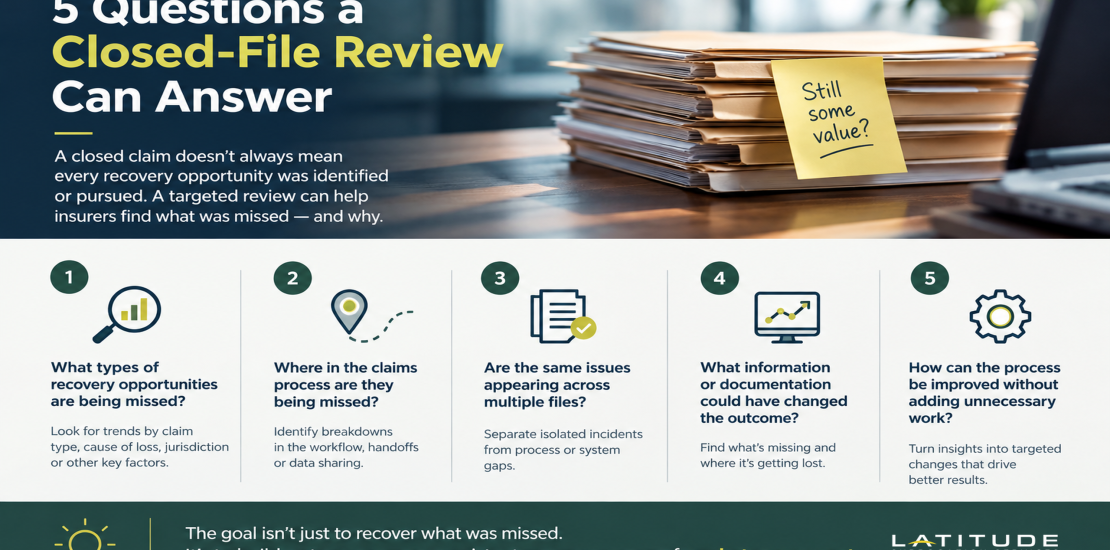
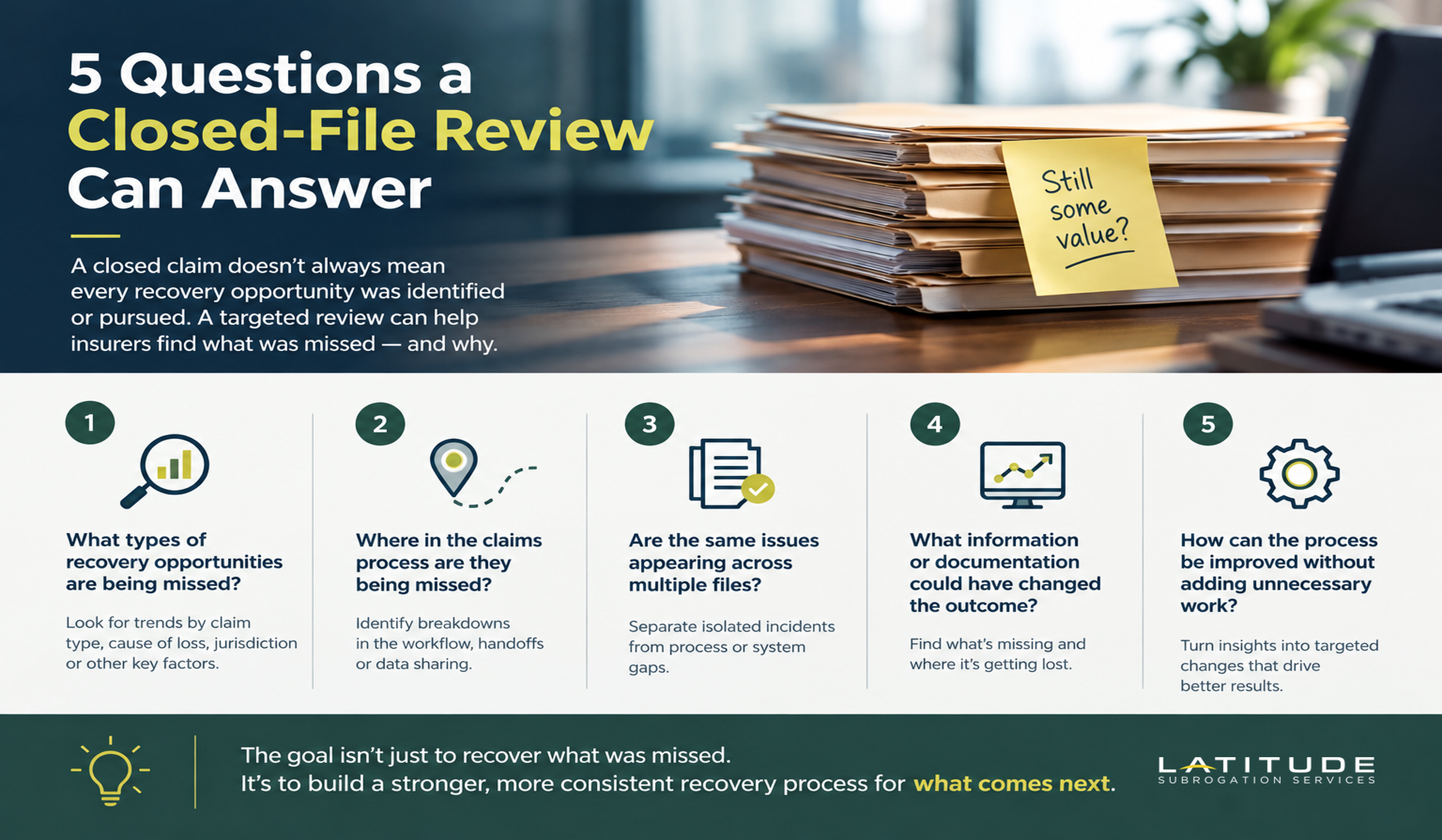
A useful review should therefore go beyond asking, “How much money was missed?” It should also ask:
- What types of recovery opportunities are being missed?
- Where in the claims process are they being missed?
- Are the same issues appearing across multiple files?
- What information or documentation could have changed the outcome?
- Can the process be improved without adding unnecessary work for claims professionals?
Those answers can be more valuable than the recovery dollars identified in a single review.
The Role of Data and Technology
Technology can play an important role in making this type of analysis practical at scale.
Claims organizations have access to more data than ever, but having data and using it effectively are different. Technology can help teams screen closed files for recurring recovery indicators, prioritize the claims most likely to warrant another look, and identify patterns that may be difficult to see through individual file reviews.
For example, data-driven scoring can help identify claims with characteristics commonly associated with recovery potential. Automated workflows can help route files for review, while analytics can reveal trends across claim types, jurisdictions, causes of loss, or other relevant characteristics.
The goal is not to replace the expertise of claims or subrogation professionals. It is to help them focus that expertise where it can have the greatest impact.
The combination of people, process, and technology can make recovery efforts more targeted and consistent.
What Closed Claims Can Reveal About Recovery
One of the most valuable outcomes of a closed-file review may not be the recovery opportunity found in a particular claim. It may be what that claim teaches the organization.
A portfolio-level review can show how consistently recovery opportunities are identified and handled across the organization. It can validate processes that are working well and highlight areas where additional training, workflow changes, technology, or specialized resources may be beneficial.
This can be especially valuable for organizations that already have established subrogation processes. An outside review can provide another perspective without requiring an insurer to redesign its entire operation.
For claims leaders, the question becomes less about whether every closed claim should be reopened and more about whether the organization has a reliable way to determine which claims deserve another look.
Turning Insight Into Action
Insurers looking to strengthen recovery performance can start with a few practical steps:
1. Review a representative sample of closed claims.
Begin with a representative sample of recently closed claims, selected across relevant claim types, outcomes, or other characteristics. The goal is to determine whether recovery opportunities are being identified and pursued consistently, not to review every closed file at once.
2. Look for patterns, not just dollars.
Identify recurring issues by claim type, workflow, documentation, liability indicators, or other characteristics.
3. Separate process problems from individual claim issues.
A missed opportunity on one file may be isolated. Repeated issues may indicate a broader process gap.
4. Use technology to prioritize.
Data and automated scoring can help identify files that warrant additional attention without requiring every claim to receive the same level of review.
5. Measure what happens next.
Use the review findings to establish a baseline, identify the process changes to be tested, and evaluate whether those changes improve recovery outcomes over time.
Recovery as Part of Claims Performance
Subrogation is sometimes viewed as a function that happens after the claim has been handled. A broader view is to consider recovery throughout the claims lifecycle and as one component of overall claims performance.
Closed-file reviews can help insurers understand what is happening after the claim itself has been resolved and, importantly, what those files can teach the organization about future claims.
The opportunity is not simply to recover money that might otherwise be left on the table. It is to use what closed claims reveal to improve the way recovery opportunities are identified, evaluated, and pursued going forward.
For insurers focused on managing loss costs, a closed claim can become more than an endpoint. It can become a source of insight for the next claim, helping organizations assess recovery performance and identify opportunities to strengthen future results.
How Latitude Helps Insurers Close the Recovery Gap
Closed-file reviews do not have to add another layer of work for internal claims teams. Latitude Subrogation Services combines experienced professionals, technology, and data-driven processes to help insurers review claims, identify overlooked recovery potential, and pursue opportunities that warrant further action. By providing an outside perspective and focused recovery support, Latitude can help insurers address individual missed recoveries while using the findings to strengthen future claims performance.
Learn more about the value Latitude can bring to AAIS Members at latitudesubro.com.